
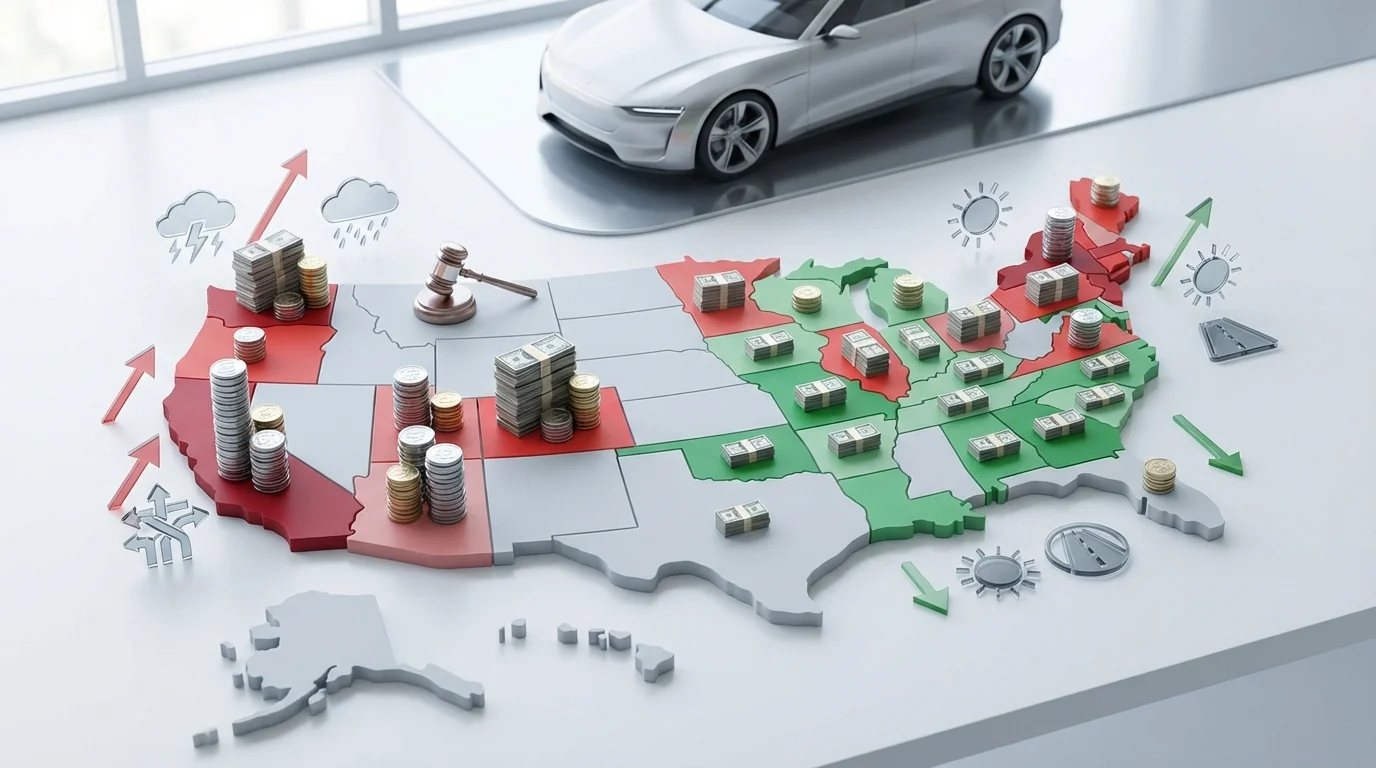
Car insurance premiums vary wildly across the United States. A driver paying $900/year in Vermont could pay $3,100/year for identical coverage in Michigan. State regulations, minimum coverage requirements, traffic density, weather patterns, and lawsuit environments all influence what you pay.
We compiled average annual premiums for all 50 states using 2026 rate data from major insurers, then identified the cheapest insurer in each state. Whether you are moving, shopping for a new policy, or just curious how your rates compare, this guide gives you the complete picture.
National Overview
National average annual premium (full coverage): $2,014 National average annual premium (liability only): $685
The 10 cheapest states average $1,100/year for full coverage. The 10 most expensive average $2,800/year. That is a $1,700 difference for the same driver with the same car and driving record.
Most Expensive States
| Rank | State | Avg Annual Premium | Key Factor |
|---|---|---|---|
| 1 | Michigan | $3,096 | Unlimited PIP requirement |
| 2 | Louisiana | $2,839 | High litigation rates |
| 3 | Florida | $2,713 | High uninsured rate, weather |
| 4 | New York | $2,651 | Dense traffic, no-fault state |
| 5 | Nevada | $2,482 | High accident rates |
| 6 | California | $2,391 | Traffic, high repair costs |
| 7 | Connecticut | $2,348 | Dense population, high COL |
| 8 | New Jersey | $2,291 | Dense traffic, no-fault state |
| 9 | Georgia | $2,264 | Urban growth, uninsured drivers |
| 10 | Texas | $2,198 | Weather, large state, uninsured rate |
Why These States Are Expensive
Michigan stands alone as the most expensive due to its unique unlimited personal injury protection (PIP) requirement. While recent reforms introduced optional PIP limits, the legacy system still drives costs higher than any other state.
Louisiana and Florida combine high uninsured driver rates (both above 15%) with active litigation environments. When uninsured drivers cause accidents, insured drivers absorb the costs through higher premiums. Both states also face significant weather risks (hurricanes, flooding).
New York and New Jersey are no-fault states with dense urban populations. No-fault systems, while designed to speed up claims, tend to increase overall costs because both parties’ insurers pay regardless of who caused the accident.
Cheapest States
| Rank | State | Avg Annual Premium | Key Factor |
|---|---|---|---|
| 1 | Maine | $987 | Low density, low claims |
| 2 | Vermont | $1,052 | Rural, low crime |
| 3 | Idaho | $1,098 | Low density, few uninsured |
| 4 | New Hampshire | $1,112 | No insurance mandate |
| 5 | Ohio | $1,145 | Competitive market |
| 6 | Iowa | $1,167 | Low density, low litigation |
| 7 | North Carolina | $1,189 | Rate regulation |
| 8 | Wisconsin | $1,201 | Low uninsured rate |
| 9 | Wyoming | $1,218 | Very low density |
| 10 | Utah | $1,245 | Young population, low claims |
Why These States Are Cheap
Maine, Vermont, and Idaho benefit from low population density, minimal traffic congestion, low crime rates, and few uninsured drivers. Fewer accidents and lower theft rates translate directly to lower premiums.
North Carolina is an outlier — it is not especially rural or low-risk, but the state’s strict rate regulation system forces insurers to justify every rate increase, keeping premiums artificially lower than neighboring states.
Ohio benefits from a highly competitive insurance market with many regional carriers competing on price, driving down costs through market pressure.
Cheapest Insurance Company by State
The cheapest insurer varies dramatically by state. Here are the most common winners:
GEICO is the cheapest option in approximately 15 states, particularly in the mid-Atlantic and Southeast. Their direct-to-consumer model eliminates agent commissions, keeping overhead low.
State Farm wins in about 12 states, especially in the Midwest and rural areas. Their massive agent network provides local service, and their size enables competitive pricing.
Progressive is often cheapest for drivers with less-than-perfect records. Their Snapshot usage-based program particularly benefits low-mileage drivers.
USAA consistently offers the lowest rates across nearly every state — but eligibility is limited to military members, veterans, and their families. If you qualify, always get a USAA quote.
Erie Insurance dominates pricing in the states where it operates (primarily Mid-Atlantic and Midwest). Its regional focus allows efficient underwriting and consistently low rates.
Regional Winners
| Region | Often Cheapest | Runner-Up |
|---|---|---|
| Northeast | Erie, GEICO | State Farm |
| Southeast | GEICO, State Farm | Progressive |
| Midwest | Erie, State Farm | GEICO |
| Southwest | GEICO, Progressive | USAA |
| West Coast | GEICO, Progressive | State Farm |
| Mountain | State Farm, GEICO | Progressive |
Factors That Affect Your Rate (Beyond State)
Your state sets the baseline, but individual factors create a wide range within any state:
Age and Experience
Young drivers (16-25) pay 2-3x the average rate. Rates decrease steadily until about age 65, then gradually increase again. The sweet spot for pricing is ages 30-60 with a clean driving record.
Driving Record
A single at-fault accident increases premiums by 40-50% for 3-5 years. A DUI can double or triple your rates. Each year of clean driving brings your rate down.
Credit Score
In 47 states, insurers use credit-based insurance scores. Moving from poor to excellent credit can reduce your premium by 30-50%. Only California, Hawaii, and Massachusetts prohibit this practice.
Vehicle Type
A Honda Civic costs 40-60% less to insure than a BMW 3 Series. Insurance considers repair costs, safety ratings, theft rates, and claim history for each vehicle model.
Coverage Level
Choosing liability-only vs. full coverage creates the biggest premium difference under your control. Full coverage (adding collision and comprehensive) typically costs 2-3x more than liability only.
ZIP Code
Rates vary by ZIP code within a state. Urban ZIP codes with high traffic, theft, and vandalism rates pay significantly more than suburban or rural codes. Moving 15 miles from a city center can save 10-20%.
How to Find the Cheapest Rate in Your State
Step 1: Get at Least 5 Quotes
This is the single most effective way to find the lowest rate. Insurance pricing algorithms differ between companies, and the cheapest option for your specific profile can only be found by comparing.
Step 2: Check Regional Carriers
National companies get the most attention, but regional carriers often offer better rates in their operating states. Ask a local independent agent about regional options.
Step 3: Ask About Every Discount
Most drivers qualify for discounts they do not know about. Common ones:
- Multi-policy (bundle home + auto): 10-25% off
- Safe driver (no claims/violations): 10-20% off
- Good student: 5-15% off
- Low mileage (under 7,500 miles/year): 5-15% off
- Defensive driving course: 5-10% off
- Autopay + paperless: 5-10% off
Step 4: Optimize Your Coverage
Review what you are paying for. Drop collision on cars worth less than $5,000. Increase deductibles if you have savings to cover them. Remove duplicate coverage (rental car if your credit card covers it).
Step 5: Reassess Annually
The cheapest company changes as your profile changes. A company that was expensive when you were 25 may be the cheapest at 35. Shop every renewal period.
Frequently Asked Questions
Why is car insurance so expensive in my state? State regulations, minimum coverage requirements, litigation environment, weather risk, uninsured driver rate, and population density all factor in. No-fault states and states with high minimum requirements tend to be the most expensive.
Can I buy car insurance from a company in a cheaper state? No. You must insure your vehicle in the state where it is registered. Your rate is based on where you live and drive, not where the insurance company is headquartered.
Is minimum coverage enough? Minimum coverage is rarely enough. State minimums are designed to be the bare legal requirement, not adequate protection. A single serious accident can easily exceed minimum limits, leaving you personally liable. We recommend at least 100/300/100 in liability.
Does where I park my car affect my rate? Yes. Garaging your car (parking in a garage) vs. street parking can reduce your comprehensive premium by 5-15%. Your address determines your rating territory.
Will my rate go down as I get older? Generally yes, from ages 25 to 65, assuming a clean driving record. After 65, rates may gradually increase due to higher accident risk statistics for senior drivers.
Find Your Best Rate
Car insurance costs vary too much between companies to accept the first quote you get. Five minutes of comparison shopping can save you hundreds of dollars per year.
Compare quotes now from top-rated insurers in your state and see how much you could be saving on your car insurance.