
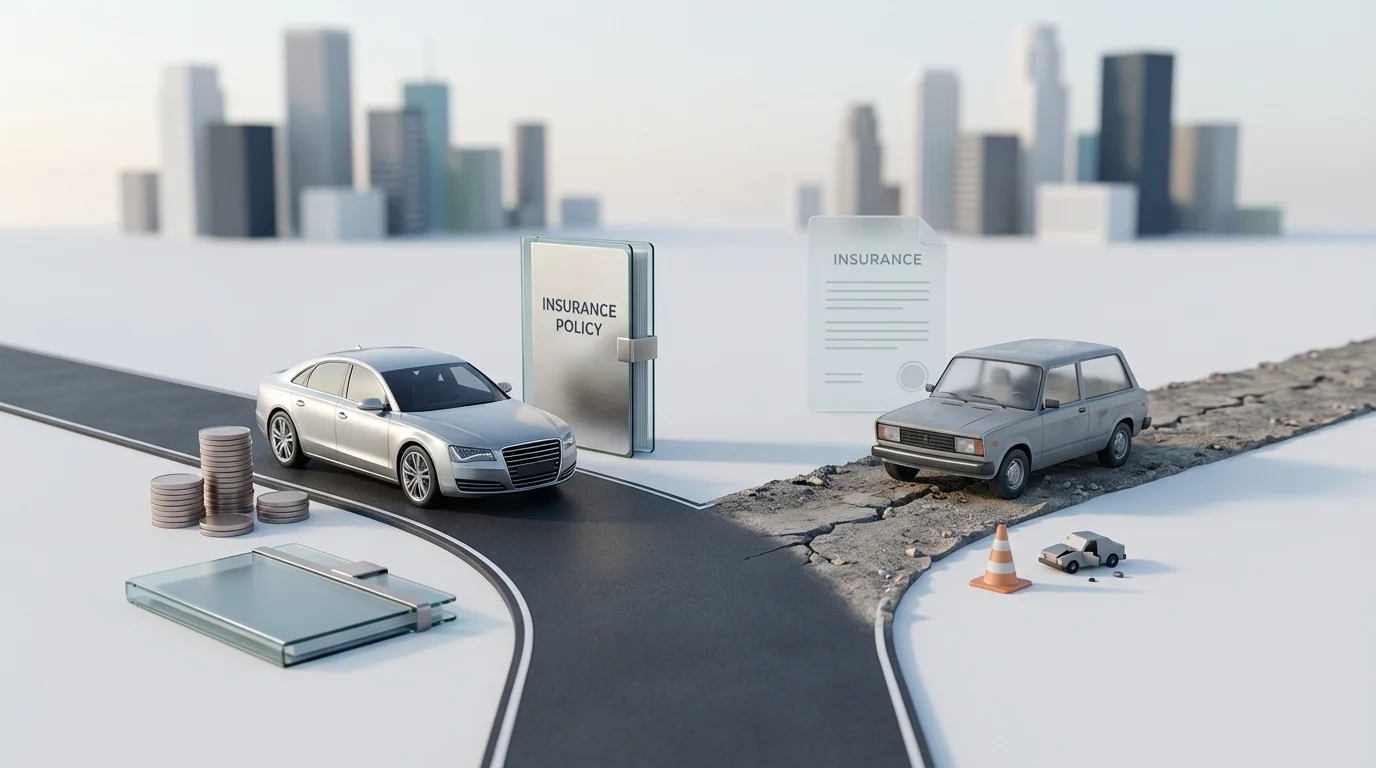
The phrase “full coverage” appears on nearly every car insurance ad, but it is one of the most misunderstood terms in the industry. Full coverage is not an official insurance term — it is shorthand for a policy that includes liability, collision, and comprehensive coverage. Liability-only, on the other hand, covers only damage you cause to other people and their property.
The cost difference is significant. The national average for full coverage is $2,014 per year, compared to $685 for liability-only — a gap of $1,329 annually. Choosing between them is one of the most impactful financial decisions you can make as a driver.
This guide breaks down exactly what each option covers, when each makes sense, and how to decide which is right for your situation.
What Liability-Only Insurance Covers
Liability insurance is the foundation of every auto policy and the minimum required by law in 49 states (New Hampshire is the exception). It covers damage you cause to others — not to yourself or your own vehicle.
Bodily Injury Liability
Pays for medical expenses, lost wages, pain and suffering, and legal defense costs when you injure someone in an accident. Coverage is expressed as two numbers:
- Per-person limit: Maximum paid for one person’s injuries (e.g., $100,000)
- Per-accident limit: Maximum paid for all injuries in one accident (e.g., $300,000)
Property Damage Liability
Pays for damage you cause to other people’s vehicles, buildings, fences, guardrails, and other property. A single number represents the maximum per accident.
What Liability Does NOT Cover
- Damage to your own vehicle (regardless of fault)
- Your own medical bills (in at-fault states)
- Theft of your vehicle
- Weather damage (hail, flooding, fallen trees)
- Animal collisions
- Vandalism
If you carry liability-only and your car is damaged or totaled in an accident you caused, you pay for repairs or replacement entirely out of pocket.
What Full Coverage Insurance Covers
Full coverage adds two critical coverages on top of liability: collision and comprehensive.
Collision Coverage
Pays to repair or replace your vehicle after a collision with another vehicle or object (guardrail, pole, ditch), regardless of who is at fault. If you caused the accident, collision covers your car. If the other driver caused it and is uninsured, collision still covers you.
Typical deductible: $500-1,000 Average annual cost: $560
Comprehensive Coverage
Pays for damage to your vehicle from events other than collisions. This includes:
- Theft and attempted theft
- Vandalism
- Hail, wind, and storm damage
- Flooding
- Fire
- Falling objects (tree branches, debris)
- Animal collisions (deer strikes account for over 1.9 million claims per year)
- Broken windshields
Typical deductible: $250-500 Average annual cost: $190
Additional Coverages Often Included
Full coverage policies typically also include:
- Uninsured/Underinsured Motorist: Covers your injuries and vehicle damage when the at-fault driver has no insurance or insufficient coverage. About 14% of US drivers are uninsured.
- Medical Payments / Personal Injury Protection (PIP): Covers your medical expenses regardless of fault.
- Rental Reimbursement: Pays for a rental car while yours is being repaired.
- Roadside Assistance: Covers towing, flat tires, lockouts, and jump starts.
Cost Comparison: Full Coverage vs Liability Only
The numbers tell a clear story:
| Coverage Level | National Average (Annual) | Monthly Cost |
|---|---|---|
| Full Coverage | $2,014 | $168 |
| Liability Only | $685 | $57 |
| Difference | $1,329 | $111 |
That $1,329 annual difference is the price of protecting your own vehicle. Whether it is worth it depends entirely on what your vehicle is worth and what you can afford to lose.
Cost by Age Group
| Age Group | Full Coverage | Liability Only | Difference |
|---|---|---|---|
| 16-19 | $5,200 | $1,800 | $3,400 |
| 20-25 | $3,600 | $1,200 | $2,400 |
| 26-35 | $2,100 | $710 | $1,390 |
| 36-55 | $1,800 | $610 | $1,190 |
| 56-65 | $1,750 | $590 | $1,160 |
| 65+ | $1,950 | $660 | $1,290 |
Young drivers see the largest gap because collision rates are highest for their age group, making collision and comprehensive coverage proportionally more expensive.
When Full Coverage Is Required
In several situations, you have no choice — full coverage is mandatory.
Financed Vehicles (Car Loan)
Every lender requires full coverage for the duration of the loan. You are driving their asset, and they need it protected. If you drop coverage, the lender will add force-placed insurance — which costs significantly more and protects only the lender, not you.
Leased Vehicles
Lease agreements require full coverage plus gap insurance (which covers the difference between your car’s value and the remaining lease balance if the car is totaled). Dropping coverage violates the lease contract.
High-Value Vehicles
If your car is worth $15,000 or more, the financial risk of going without collision and comprehensive coverage is substantial. A single accident, hail storm, or theft could mean a $15,000+ loss.
When Liability-Only Makes Sense
Liability-only is not always the wrong choice. In specific situations, it is the smarter financial decision.
Older Vehicles Worth Less Than $5,000
If your car’s market value is $4,000-5,000 or less, full coverage may cost more than the car is worth within 2-3 years. The annual cost of collision and comprehensive ($750 on average) compared to the potential payout (the car’s value minus your deductible) creates diminishing returns.
The 10% Rule: If your annual collision + comprehensive premiums exceed 10% of your car’s current value, liability-only is likely the better financial choice. For a car worth $4,000, if collision + comprehensive costs more than $400/year, consider dropping them.
Strong Emergency Fund
If you have $5,000-10,000 in savings and can absorb the cost of replacing your vehicle without financial hardship, self-insuring through liability-only becomes viable even for moderately valued cars. You are essentially betting that your savings can cover what insurance would.
Very Low Annual Mileage
Drivers who put fewer than 3,000-5,000 miles on their car annually face significantly lower collision risk. If you work from home and only drive for errands, the statistical likelihood of a collision drops substantially.
Second or Third Vehicle
If you have a backup vehicle and your secondary car is older and low-value, liability-only on the secondary car makes sense. You do not depend on it for daily transportation.
The Deductible Decision
Your deductible — the amount you pay out of pocket before insurance kicks in — dramatically affects your premium.
| Deductible | Avg Annual Savings vs $500 Deductible | Best For |
|---|---|---|
| $250 | +$120 (costs more) | Frequent claims, tight cash flow |
| $500 | Baseline | Most drivers |
| $1,000 | -$180 (saves money) | Strong savings, infrequent claims |
| $2,000 | -$280 (saves more) | Very strong savings, low risk tolerance for small claims |
Our recommendation: Choose a $1,000 deductible if you have at least $1,000 in savings. The annual premium savings usually exceed the additional out-of-pocket risk within 2-3 years.
State Minimum Requirements
Every state sets minimum liability requirements. These represent the legal floor — not recommended coverage.
| State Category | Typical Minimums | States |
|---|---|---|
| Lowest minimums | 15/30/5 or 25/50/10 | CA, FL, NJ, PA |
| Moderate minimums | 25/50/25 or 30/60/25 | TX, OH, GA, NC |
| Higher minimums | 50/100/25 or 100/300/100 | AK, ME, WV |
| No-fault states | Liability + PIP required | MI, FL, NY, NJ (12 states) |
Important: State minimums are dangerously low. A serious accident involving injuries easily generates $100,000+ in medical bills and lost wages. If your liability limits are $25,000 per person and the injured party’s bills reach $150,000, you are personally liable for the $125,000 difference. We recommend at least 100/300/100 regardless of state minimums.
How to Decide: A Simple Framework
Answer these three questions:
1. Is your car financed or leased?
Yes = Full coverage required. No choice.
2. What is your car worth?
- Over $10,000 = Full coverage strongly recommended
- $5,000-10,000 = Full coverage recommended unless you have strong savings
- Under $5,000 = Liability-only is likely the better value
3. Can you afford to replace your car out of pocket?
- No = Full coverage protects you from a devastating financial loss
- Yes = Liability-only saves you money, and you self-insure the difference
Frequently Asked Questions
Is full coverage really worth the extra cost? For vehicles worth over $10,000 or any financed/leased vehicle, yes. The extra $1,000-1,500 per year protects an asset worth $10,000-40,000+. For older cars worth under $5,000, the math often favors liability-only. Calculate the 10% rule for your specific situation.
What happens if I have liability-only and someone hits me? If the other driver is at fault and has insurance, their liability coverage pays for your vehicle damage and medical bills. The risk with liability-only is when the at-fault driver is uninsured (14% of drivers are) or when you cause the accident yourself — in those cases, you get nothing for your own vehicle.
Can I switch from full coverage to liability-only mid-policy? Yes, you can reduce coverage at any time (unless your lender requires full coverage). Contact your insurer to remove collision and comprehensive. Your premium will be adjusted for the remaining policy period. There is no penalty for reducing coverage.
Does liability-only cover me if I hit a deer? No. Animal collisions fall under comprehensive coverage. If you have liability-only and hit a deer, you pay for all vehicle repairs yourself. In states with high deer populations (Michigan, Pennsylvania, Wisconsin), comprehensive coverage can be worth keeping even on older vehicles.
What is gap insurance, and do I need it? Gap insurance covers the difference between what your car is worth and what you owe on a loan or lease. If your car is totaled and worth $18,000 but you owe $24,000, gap insurance pays the $6,000 difference. You need it if you are upside-down on your loan or if you leased your vehicle.
Make the Right Coverage Choice
The full coverage vs liability-only decision comes down to one question: can you afford to absorb the financial loss of your vehicle? If the answer is no, full coverage is not optional — it is essential protection. If the answer is yes and your car’s value does not justify the premium, liability-only puts $1,000+ back in your pocket every year.
Get a free quote today with both coverage levels side by side. See exactly what full coverage costs for your car versus liability-only, and make an informed decision based on your specific numbers.