
If you drive for Uber, Lyft, or any other rideshare platform, there is a dangerous gap in your insurance that most drivers do not discover until they file a claim. Personal auto insurance excludes commercial activity — including rideshare driving. And while Uber and Lyft provide some insurance, it does not cover every situation.
This gap can leave you personally liable for thousands of dollars in accident costs. Understanding when your personal policy applies, when the rideshare company’s policy applies, and when neither covers you is essential for every rideshare driver.
This guide explains the coverage gaps, your options for closing them, and what it costs to drive with full protection.
The Rideshare Insurance Gap Explained
When you drive for a rideshare company, your insurance situation changes depending on what you are doing at any given moment. The problem is that there are periods when neither your personal auto policy nor the rideshare company’s policy provides full coverage.
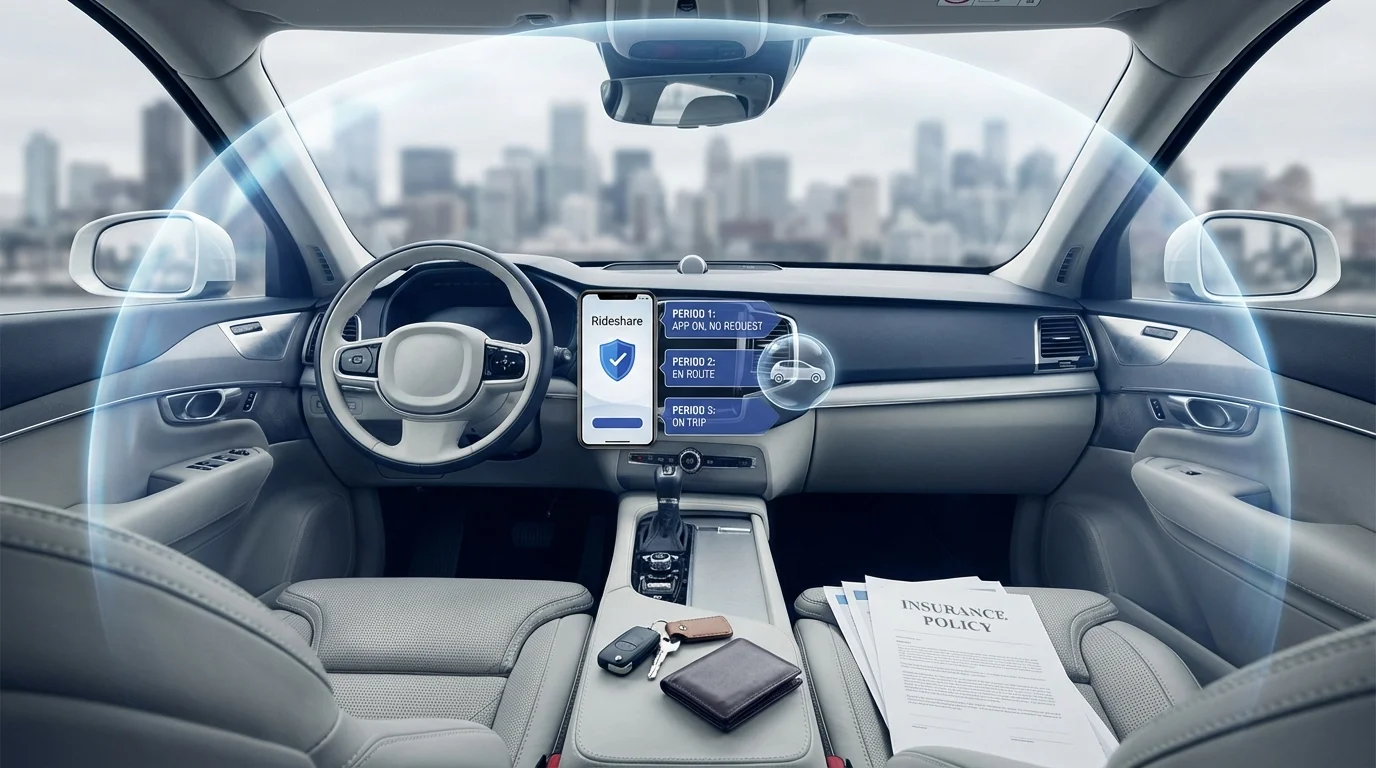
The Three Periods of Rideshare Driving
Rideshare insurance is defined by three distinct periods:
Period 0: App Off (Personal Driving) You are driving your car for personal reasons with the rideshare app turned off. Your personal auto insurance applies fully, just like any other driver.
Period 1: App On, Waiting for a Ride Request You have the app open and are available for ride requests, but have not yet accepted one. This is where the most dangerous coverage gap exists.
- Your personal auto policy: Likely denies claims (commercial activity exclusion)
- Uber/Lyft coverage: Minimal — typically only liability at low limits ($50,000/$100,000/$25,000)
- Your own vehicle: Not covered by either policy
Period 2: En Route to Pick Up a Passenger You have accepted a ride request and are driving to the pickup location.
- Your personal auto policy: Denies claims
- Uber/Lyft coverage: Full coverage — $1 million liability, collision, and comprehensive (subject to deductible)
- Deductible: $2,500 (Uber) or $2,500 (Lyft) for collision/comprehensive
Period 3: Passenger in the Vehicle You have a passenger in the car and are driving to their destination.
- Your personal auto policy: Denies claims
- Uber/Lyft coverage: Full coverage — $1 million liability, collision, and comprehensive (subject to deductible)
- Deductible: $2,500 (Uber) or $2,500 (Lyft) for collision/comprehensive
Where the Gap Hurts Most
Period 1 is the danger zone. You are actively working (app on, waiting for a request), but neither your personal insurer nor the rideshare company provides full coverage. If you cause an accident during Period 1:
- Your personal insurer will likely deny the claim because you were engaged in commercial activity
- Uber/Lyft provide only minimum liability coverage — no collision or comprehensive for your own vehicle
- You pay for your own vehicle damage and any liability above the rideshare company’s low limits out of pocket
A serious Period 1 accident can easily result in $10,000-30,000+ in uninsured costs.
Rideshare Insurance Options
There are three ways to close the coverage gap: a rideshare endorsement, a commercial auto policy, or a hybrid policy from a rideshare-friendly insurer.
Option 1: Rideshare Endorsement (Most Common)
A rideshare endorsement (also called a TNC endorsement or rideshare rider) is an add-on to your existing personal auto policy that extends coverage to all periods of rideshare driving, including the Period 1 gap.
Cost: $15-30 per month ($180-360 per year) What it covers: Extends your personal policy to cover Periods 1, 2, and 3 What it does not cover: Does not replace the rideshare company’s coverage during Periods 2 and 3 — it fills gaps and provides primary coverage during Period 1
This is the most cost-effective solution for most part-time rideshare drivers. The endorsement typically costs 15-25% of your base auto premium.
Option 2: Commercial Auto Insurance
A full commercial auto policy covers all business use of your vehicle, including rideshare driving. It provides comprehensive coverage during all periods without relying on the rideshare company’s insurance at all.
Cost: $150-300 per month ($1,800-3,600 per year) What it covers: All driving activity — personal and commercial Best for: Full-time rideshare drivers who drive 30+ hours per week
Commercial policies are expensive but provide the strongest protection. They are rarely necessary for part-time drivers who only work 10-15 hours per week.
Option 3: Hybrid Rideshare Policy
Some insurers now offer policies specifically designed for rideshare drivers that combine personal and commercial coverage in a single product. These are priced between a personal policy with a rideshare endorsement and a full commercial policy.
Cost: $80-180 per month ($960-2,160 per year) What it covers: Seamless coverage across all periods with lower deductibles than rideshare company insurance Best for: Drivers who work 15-30 hours per week for rideshare
Best Companies for Rideshare Drivers
Allstate
Ride for Hire endorsement
- Available in most states
- Covers Period 1 gap
- Cost: $15-25/month added to existing policy
- Also covers food delivery (DoorDash, Uber Eats, etc.)
Progressive
Rideshare endorsement
- Available in most states
- Covers all periods of rideshare driving
- Cost: $20-30/month
- Integrates with Snapshot driving data for additional discounts
State Farm
Rideshare endorsement
- Available in a growing number of states
- Extends personal coverage to all rideshare periods
- Cost: $15-25/month
- Works with Drive Safe & Save telematics
GEICO
Rideshare endorsement
- Available in most states
- Covers the Period 1 gap
- Cost: $15-20/month
- One of the most affordable options
USAA
Rideshare endorsement
- Available to military members and families
- Covers all rideshare periods
- Cost: $10-20/month
- Lowest cost option (for eligible drivers)
Farmers Insurance
Rideshare endorsement
- Available in most states
- Covers Period 1 with option for enhanced coverage
- Cost: $15-25/month
- Also covers delivery services
What Uber and Lyft Insurance Actually Covers
Understanding the rideshare company’s insurance helps you identify exactly what gaps you need to fill.
Uber Insurance Coverage
| Period | Liability | Collision/Comp | Deductible |
|---|---|---|---|
| Period 1 (app on, no request) | $50K/$100K/$25K | None | N/A |
| Period 2 (en route to pickup) | $1 million | Yes (if you carry it personally) | $2,500 |
| Period 3 (passenger in car) | $1 million | Yes (if you carry it personally) | $2,500 |
Lyft Insurance Coverage
| Period | Liability | Collision/Comp | Deductible |
|---|---|---|---|
| Period 1 (app on, no request) | $50K/$100K/$25K | None | N/A |
| Period 2 (en route to pickup) | $1 million | Yes (if you carry it personally) | $2,500 |
| Period 3 (passenger in car) | $1 million | Yes (if you carry it personally) | $2,500 |
Critical detail: Uber and Lyft’s collision and comprehensive coverage during Periods 2 and 3 only applies if you already carry collision and comprehensive on your personal policy. If you have liability-only personal insurance, the rideshare company also only provides liability during these periods.
The $2,500 deductible: This is significantly higher than the typical $500-1,000 deductible on a personal policy. Every collision claim through the rideshare company costs you $2,500 out of pocket before any coverage kicks in. A rideshare endorsement on your personal policy can reduce this deductible to your personal policy’s level ($500-1,000).
Cost Breakdown: Is Rideshare Insurance Worth It?
Let us calculate the real numbers for a typical part-time rideshare driver.
Without Rideshare Endorsement
- Personal auto policy: $168/month ($2,014/year)
- Period 1 coverage gap: Uninsured for your own vehicle
- Period 2-3 deductible: $2,500 per claim
- Risk: Claim denial if personal insurer discovers rideshare activity
With Rideshare Endorsement
- Personal auto policy: $168/month ($2,014/year)
- Rideshare endorsement: $20/month ($240/year)
- Total: $188/month ($2,254/year)
- Period 1: Fully covered
- Period 2-3 deductible: Your personal policy deductible ($500-1,000)
- Risk: Minimal — full coverage at all times
The endorsement costs $240/year and saves you the $2,500 deductible difference on any single claim, plus it provides the only coverage for your vehicle during Period 1. For a driver working even a few hours per week, this is among the best insurance values available.
Earning Enough to Cover the Cost
At average rideshare earnings of $15-25 per hour after expenses, the $240 annual endorsement cost is covered by approximately 10-16 hours of driving per year — less than one shift. Every hour beyond that earns you money with full insurance protection.
Food Delivery and Other Gig Driving
Rideshare endorsements typically also cover food delivery services (DoorDash, Uber Eats, Grubhub, Instacart). The coverage structure is similar:
- App on, waiting for an order: Coverage gap exists (same as Period 1)
- Picking up / delivering an order: Commercial activity, personal policy may deny claims
- Rideshare endorsement: Covers all delivery driving periods
If you do both rideshare and delivery driving, a single rideshare endorsement usually covers both activities. Confirm with your insurer that their endorsement specifically includes delivery services.
State-by-State Requirements
Insurance requirements for rideshare drivers vary significantly by state:
States requiring rideshare-specific insurance: Colorado, Georgia, Illinois, Maryland, Virginia, and Washington require rideshare companies to provide minimum insurance during all periods, or require drivers to carry rideshare endorsements.
States with minimal regulation: Some states have limited rideshare insurance requirements, placing more responsibility on the driver to secure adequate coverage.
Key state variations:
- California: Requires $1 million liability during Periods 2 and 3; $50K/$100K/$30K during Period 1
- New York: Requires $1.25 million combined during all active periods
- Texas: Follows the standard Uber/Lyft coverage model with minimal Period 1 requirements
- Florida: Requires $50K/$100K/$25K during Period 1; $1 million during Periods 2 and 3
Regardless of your state’s requirements, carrying a rideshare endorsement is strongly recommended. State minimums protect other parties — the endorsement protects you and your vehicle.
Frequently Asked Questions
Will my personal auto insurance cover me while driving for Uber or Lyft? Almost certainly not during active rideshare periods. Personal auto policies include commercial activity exclusions that apply to rideshare driving. If you file a claim and your insurer discovers you were driving for a rideshare company, they can deny the claim and potentially cancel your policy. A rideshare endorsement ($15-30/month) removes this risk.
What happens if I do not tell my insurer I drive for Uber? If you have an accident while ridesharing and file a claim without disclosing your rideshare activity, your insurer can deny the claim, cancel your policy for misrepresentation, and you could be left with no coverage and a personal liability of tens of thousands of dollars. It is never worth the risk.
Does Uber or Lyft insurance cover my car if it is totaled? During Periods 2 and 3, yes — but only if you carry collision coverage on your personal policy, and subject to a $2,500 deductible. During Period 1, neither Uber nor Lyft covers your vehicle at all. This is the most critical gap that a rideshare endorsement fills.
How much does rideshare insurance cost? A rideshare endorsement on your personal policy costs $15-30/month ($180-360/year). A full commercial auto policy costs $150-300/month ($1,800-3,600/year). For most part-time rideshare drivers, the endorsement is the cost-effective choice.
Can I drive for multiple rideshare and delivery apps with one endorsement? In most cases, yes. Most rideshare endorsements cover driving for any Transportation Network Company (TNC) and many also cover food delivery services. Confirm with your specific insurer that their endorsement covers all the platforms you use.
Protect Your Rideshare Income
Rideshare driving is a flexible way to earn income, but driving uninsured or underinsured puts everything at risk — your car, your earnings, and your personal assets. The cost of proper rideshare coverage ($15-30/month) is a fraction of what you earn and eliminates the coverage gaps that could otherwise cost you thousands.
Get a free rideshare insurance quote today. Compare endorsement costs from top insurers and find the most affordable way to drive with full protection. Your next ride request should not be a financial gamble.